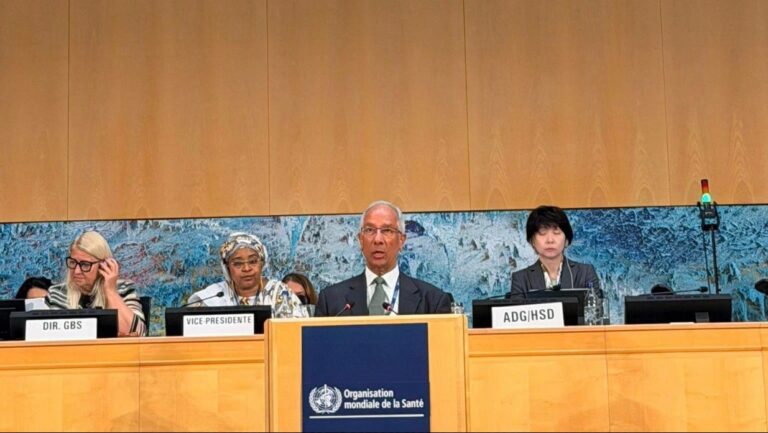
The OIC General Secretariat delegation, led by Assistant Secretary-General for Science and Technology Ambassador Aftab Ahmad Khokher, attended the 79th World Health Assembly (WHA 79), held on 18–23 May 2026 in Geneva. WHA 79’s main theme was “Reshaping Global Health: A Shared Responsibility.” The OIC delegation included Ambassador Saeed Sarwar, OIC Permanent Representative to the UN, and Ms Yasmin Eren, Professional Officer.
The ASG Ambassador Khokher, in his address at the Assembly, underscored that building resilient and inclusive health systems was a shared global responsibility and called for equitable access to healthcare, medicines, vaccines, and essential technologies. He highlighted that the OIC’s Strategic Health Program of Action prioritised stronger health systems, disease prevention, and maternal and child health. He also emphasised the importance of emergency preparedness, coordinated responses, and South-South cooperation, particularly through health workforce development, technology transfer, and investment in medical infrastructure.
The ASG Ambassador Khokher also delivered a keynote address at a special event titled “Health Financing: Bringing Traditional and Innovative Financing for Universal Health Coverage.” The event was jointly organised by Jordan, Türkiye, Syria, Burkina Faso, and the OIC General Secretariat. He highlighted the need to expand traditional and innovative financing, including Islamic social finance instruments such as waqf, zakat, and sukuk, to advance UHC across OIC Member States.
The ASG Ambassador Khokher held a series of bilateral meetings with Ministers and Heads of Delegation of OIC Member States, including from the Republic of Türkiye, the Islamic Republic of Pakistan, the Republic of the Gambia, the Cooperative Republic of Guyana, and the Republic of Senegal, as well as with senior WHO officials and Gavi, the Vaccine Alliance, to further strengthen cooperation on global health priorities.
WHA 79 brought together delegations from WHO Member States and international organisations to address key global health priorities, including sustainable financing for the global health architecture, challenges to Universal Health Coverage (UHC) and primary health care, antimicrobial resistance, climate change and health, health emergencies preparedness, non-communicable diseases, and the protection of health in humanitarian and conflict-affected setting, as well as the grave health conditions in the occupied Palestinian territory, including occupied Al-Quds (Jerusalem) and the occupied Syrian Golan.