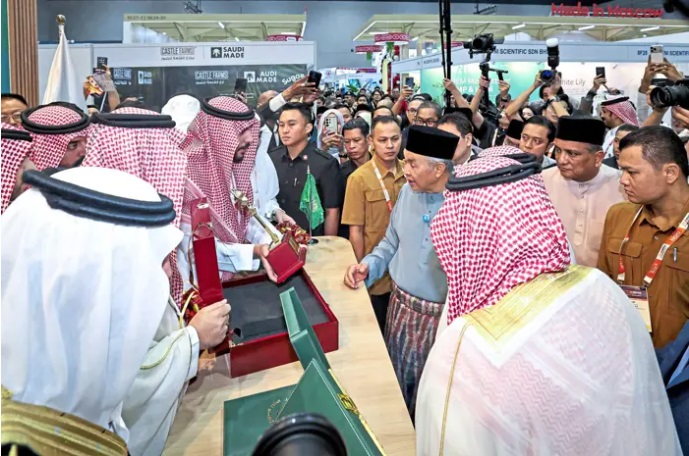
KUALA LUMPUR: A Malaysia-Indonesia Halal Council will be set up to strengthen halal diplomacy between the two countries, Datuk Seri Dr Ahmad Zahid Hamidi announced.
The Deputy Prime Minister said the council would be chaired by Indonesia’s Halal Product Assurance Organising Agency (BPJPH), with Malaysia serving as its secretary-general.
The council’s maiden meeting will be held in October, he added.
“Next month, the focus will be on facilitating halal certification between Malaysia and Indonesia. This is to ease bilateral halal trade between the two countries,” he said at the Global Halal Summit 2026.
Ahmad Zahid said the council would build on existing bilateral cooperation between Malaysia and Indonesia to address differing halal requirements, repeated procedures and difficulties faced by businesses seeking to enter neighbouring markets.
Malaysia and Indonesia signed a memorandum of cooperation in 2023, while bilateral negotiations on facilitating halal certification and trade between the two countries were concluded in June this year, he said.
The Deputy Prime Minister said closer bilateral cooperation could identify practical ways to facilitate trade, reduce duplication and connect businesses to regional supply chains.
He said Malaysia brings experience in standards, governance, Islamic finance and trade facilitation, while Indonesia offers scale, production capacity and entrepreneurship, which are at the core of halal diplomacy, where both parties can leverage the trust built to open markets, facilitate investment and create opportunities together.
Ahmad Zahid said that such cooperation should ultimately translate into fewer barriers, easier market access and more companies trading across borders.
He said small manufacturers should have a clearer route to overseas buyers, while halal-certified companies should receive the support needed to fulfil their first export orders.
“The future of halal will depend on how effectively we connect ourselves and build that trust in the future,” he said.
Malaysia aims to increase its halal exports to about RM80bil by 2030, he added, Bernama reported.
Ahmad Zahid noted that the halal industry contributed about 11% to Malaysia’s gross domestic product, yet only about 14.7% of halal-certified companies were exporters.
“To realise our ambition, we must help more of these companies compete abroad.
“Certification is only the beginning of that journey. Companies also need consistent production, suitable packaging, working capital, reliable logistics and an understanding of their target markets,” he added.
Meanwhile, Ahmad Zahid said the International Halal Showcase (Mihas) 2026 has attracted US$1.2bil in sales over the first two days.
The event is hosted by the Ministry of International Trade and Industry and organised by the Malaysia External Trade Development Corporation.
He commended the annual organisation of Mihas, saying that it has established the event as a global halal exhibition brand, despite several countries also organising similar exhibitions.
This year’s edition, which features 2,000 booths, 1,700 exhibitors and 450 buyers representing 58 countries, had drawn 30,000 visitors, demonstrating sustained local and international interest and putting it on track to be the most attended edition of Mihas to date.
“Further cementing its role as a platform for tangible international partnerships, Mihas 2026 witnessed the exchange of key strategic agreements, including a milestone Letter of Intent between the Matrade and the Department of Islamic Development (Jakim),” Matrade said in a statement.