SESRIC Report Highlights the Economic Performance, Structural Challenges and Cooperation Potential of OIC Member Countries
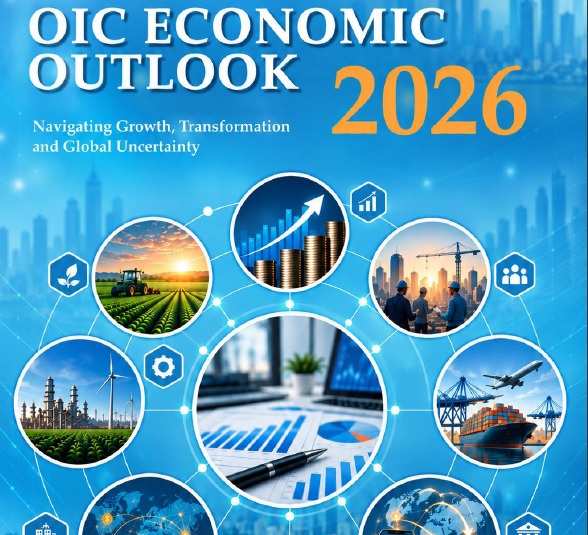
The Statistical, Economic and Social Research and Training Centre for Islamic Countries (SESRIC) has released its flagship publication, OIC Economic Outlook 2026: Navigating Growth, Transformation and Global Uncertainty. The report provides a comprehensive assessment of the economic performance of the 57 OIC Member States, examining their growth prospects, structural transformation, labour markets, international trade, investment flows and external financing conditions.
Published against a backdrop of geopolitical tensions, changing global trade patterns, technological transformation and tighter financing conditions, the report highlights both the growing economic significance of OIC countries and the need to translate their collective potential into stronger productive capacity, deeper economic integration and sustainable development.
1. Economic Growth and the Changing Structure of OIC Economies
According to the report, the combined Gross Domestic Product (GDP) of OIC Member States reached approximately US$10.04 trillion in 2025, representing 8.5% of global GDP at current prices and 15% in purchasing power parity terms. With a combined population exceeding two billion people, OIC countries represent approximately one-quarter of the world’s population and constitute a significant consumer market and source of productive potential.
OIC economies recorded an aggregate growth rate of 4.1% in 2025, outperforming global economic growth of 3.5%. However, the report projects growth to moderate to 3.1% in 2026, before recovering to 4.6% in 2027.
The report also identifies gradual changes in the productive structure of OIC economies. Manufacturing increased its share of total value added from 13.9% in 2010 to 15.9% in 2024, while services have also gained importance. Nevertheless, the pace of structural transformation differs considerably among Member States, with several economies continuing to rely heavily on agriculture, hydrocarbons and other primary industries.
These developments underline the importance of economic diversification, industrial development, technological upgrading and greater domestic value addition.
2. International Trade: A Record in Intra-OIC Trade
One of the most significant findings of the report concerns the expansion of trade among OIC Member States.
Merchandise exports from OIC countries increased by 5.9% in 2025, reaching US$2.64 trillion. More importantly, intra-OIC merchandise trade grew by 8.2% to a record US$555 billion, raising its share in total OIC merchandise trade to 20.1%.
Despite this progress, intra-OIC trade remains below the 25% target established in the OIC Programme of Action. This gap highlights the considerable untapped potential for expanding commercial relations among Member States.
The report emphasizes that stronger trade linkages can help diversify export markets, strengthen regional and cross-border supply chains, improve market access and create new opportunities for businesses. Greater cooperation can also enable countries to benefit from their complementary productive capacities, natural resources, industrial capabilities and consumer markets.
For this purpose, improving trade facilitation, strengthening transport and logistics connectivity, addressing trade barriers and enhancing cooperation between public and private sector institutions remain important priorities.
3. Foreign Direct Investment and Financing for Development
Foreign direct investment (FDI) remains another important area of opportunity for OIC economies.
The report indicates that OIC countries attracted approximately US$220 billion in FDI inflows in 2025, equivalent to 13.5% of global FDI inflows. Their accumulated inward FDI stock reached US$3.22 trillion.
The report stresses that attracting investment alone is not sufficient. Investment policies should focus on generating productive capacity, transferring technology, creating employment, supporting industrial development and strengthening domestic and regional economic linkages.
At the same time, external financing conditions remain challenging for a number of Member States. Rising debt-service obligations, differences in access to development finance and external vulnerabilities continue to constrain investment and economic development, particularly in lower-income, least-developed and conflict-affected countries.
Strengthening investment cooperation, mobilising private capital and improving the quality and effectiveness of financing are therefore essential for sustainable economic progress.
4. Labour Markets, Human Capital and Employment Challenges
OIC countries possess a substantial demographic advantage, but converting this potential into economic growth requires investment in human capital and productive employment.
The report estimates that the labour force of OIC Member States reached 826 million people in 2025 and is projected to increase to approximately 860 million by 2027.
Although labour market indicators have improved in recent years, important challenges remain. In 2025, the youth population not in employment, education or training (NEET) accounted for 24.1% in OIC countries, compared with the global average of 20%.
The report highlights the need to strengthen vocational and technical education, develop digital and professional skills, improve school-to-work transitions and expand employment opportunities for young people and women. These measures are particularly important in the context of technological change and the evolving demands of labour markets.
5. Key Challenges and Policy Priorities
Despite their economic progress, OIC Member States face significant differences in macroeconomic stability, inflation, fiscal conditions and external vulnerabilities. Geopolitical tensions and disruptions to major transport routes, energy markets and global supply chains may further affect trade, investment and financing conditions.
The report identifies several priorities for strengthening the economic resilience and development prospects of OIC countries:
- Economic diversification: Expanding manufacturing, services and higher value-added activities to reduce dependence on limited sectors and commodities.
- Trade integration: Deepening intra-OIC trade, improving market access and strengthening regional and cross-border supply chains.
- Quality investment: Attracting productive investment that supports technology transfer, employment and industrial development.
- Human capital development: Investing in skills, vocational training and employment opportunities, particularly for young people and women.
- Macroeconomic stability: Strengthening fiscal management, price stability and external debt sustainability.
- Institutional and economic cooperation: Improving coordination among Member States and OIC institutions to translate shared economic objectives into practical initiatives.
Conclusion: Turning Collective Economic Potential into Shared Prosperity
The OIC Economic Outlook 2026 demonstrates that OIC Member States have considerable economic resources, expanding markets and significant opportunities for cooperation. The record level of intra-OIC trade and the growing contribution of manufacturing and services provide encouraging signs of progress.
Nevertheless, the report makes clear that sustainable economic growth requires more than favourable aggregate indicators. Stronger productive capacities, diversified economies, improved trade and investment connectivity, and effective cooperation mechanisms are essential to achieving more balanced and resilient development.
In this context, expanding economic and commercial relations among OIC Member States, facilitating private-sector participation and identifying complementary trade and investment opportunities can play a significant role in translating the collective potential of the Islamic world into tangible economic benefits.
Source: Statistical, Economic and Social Research and Training Centre for Islamic Countries (SESRIC), OIC Economic Outlook 2026: Navigating Growth, Transformation and Global Uncertainty, October 2026.