Seyed Hossein Salimi, a member of the Board of Representatives of the Iran Chamber of Commerce, Industries, Mines and Agriculture (ICCIMA), Advisor to the President of ICCIMA on Foreign Investment Affairs, and a member of the Board of Directors of the Islamic Chamber Research and Information Center (ICRIC), proposed establishing a joint working group between the Islamic Chamber of Commerce and Development (ICCD) and national chambers of commerce to identify and facilitate the implementation of investment projects. Speaking at the first high-level panel of the Second B57+ Business Leaders Summit in Istanbul, he emphasized the importance of reducing financing costs and strengthening private-sector cooperation among OIC member countries.
A delegation from the Iran Chamber of Commerce, Industries, Mines and Agriculture (ICCIMA), headed by Mohammad Reza Bahraman, participated in the Second B57+ Business Leaders Summit in Istanbul. The delegation also included Mohammad Reza Karbasi, Director General of the Islamic Chamber Research and Information Center (ICRIC), and Hossein Salimi, a member of ICRIC’s Board of Directors.
The summit was held on October 31 and November 1, 2026, under the theme “The Great Convergence: Mobilizing OIC Capital for Global South Resilience.” It was organized in cooperation with the Islamic Chamber of Commerce and Development (ICCD), the Union of Chambers and Commodity Exchanges of Türkiye (TOBB), and the Standing Committee for Economic and Commercial Cooperation of the Organization of Islamic Cooperation (COMCEC).
The main summit proceedings took place on November 1 at the Beyazıt Hall of the Istanbul Congress Center, while specialized pre-summit meetings were held on October 31 at designated venues, including the TOBB building.
According to the official programme, the opening ceremony was scheduled to feature addresses by Rifat Hisarcıklıoğlu, President of TOBB; Abdullah Saleh Kamel, President of the Islamic Chamber of Commerce and Development; Ahmad Sengendo, Assistant Secretary-General of the Organization of Islamic Cooperation for Economic Affairs; and Ömer Bolat, Minister of Trade of Türkiye.
Salimi’s Participation in the First High-Level Panel
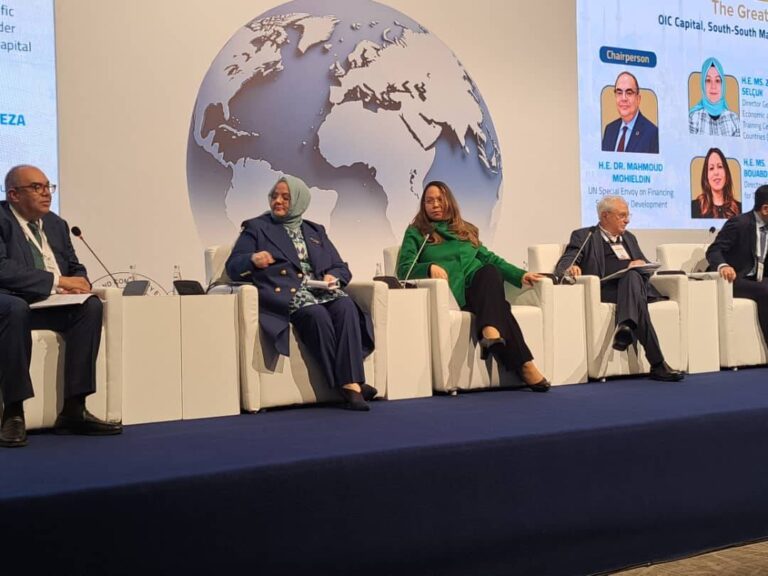
The first high-level panel of the summit, entitled “The Great Convergence: OIC Capital, South-South Markets and Global South Resilience,” provided a platform for presenting the perspectives of Iran’s private sector.
The panel was moderated by Mahmoud Mohieldin, United Nations Special Envoy on Financing the 2030 Agenda for Sustainable Development.
Other panelists included Zehra Zümrüt Selçuk, Director General of the Statistical, Economic and Social Research and Training Centre for Islamic Countries (SESRIC); Irshad Rasheed, President of the B57+ Asia-Pacific Regional Chapter; and Latifa Elbouabdellaoui, Director General of the Islamic Centre for Development of Trade (ICDT).
The discussions focused on mobilizing capital from OIC member countries, expanding cooperation with South-South markets, and strengthening the economic resilience of the Global South.
Within this framework, Salimi addressed two key questions concerning the reduction of financing costs and cross-border investment risks, as well as the practical role of chambers of commerce in transforming economic opportunities into implementable projects.
Referring to the considerable potential of OIC countries in natural resources, energy, human capital, consumer markets, production capacity, and financial resources, Salimi stressed that the joint utilization of these capacities remains far below its achievable potential.
He noted that the principal challenge facing the private sector is to create the conditions necessary to transform economic opportunities into actual investment, production, and employment.
Salimi identified three complementary priorities: reducing investment risks and costs, developing bankable projects, and establishing effective and sustainable connections among the private sectors of OIC member countries.
He emphasized that joint investment projects must have clearly defined technical and economic feasibility studies, legal structures, regulatory permits, target markets, and investment return mechanisms to enable investors to assess opportunities and make informed participation decisions.
Risk Sharing and the Strategic Use of Development Finance
Responding to the first question concerning high financing costs, country and currency risks, and limited access to long-term financing, Salimi stated that investment becomes viable when a project’s expected returns are proportionate to the risks undertaken.
He explained that reducing the cost of capital requires effective management of actual risks and preventing otherwise viable projects from bearing excessive financing costs resulting from disproportionate risk assessments.
Salimi highlighted the need to develop risk-sharing and risk-mitigation mechanisms, emphasizing that the entire risk burden of a project should not rest solely on investors or financing institutions.
He explained that investment insurance institutions, export credit guarantee funds, and development finance institutions can, within their respective mandates, help manage political risks, non-payment risks, and other insurable or mitigable risks.
The ICCIMA representative also called for the strategic deployment of development finance resources to facilitate greater private-sector investment.